
If you share your home with an indoor cat, you have probably seen it: the cat sitting at the window, watching birds, or waiting by the door when you come home. Some owners wonder whether to let them out, and if so, how to do it safely.
There is no single right answer. Outdoor time can enrich an indoor cat’s life, but it is not suitable or necessary for every cat. This guide looks at the options honestly, including their limits, so you can decide what fits your cat.
First, does your cat actually want to go out?
Not every indoor cat is asking for outdoor time. Some are perfectly content indoors, with climbing shelves, window perches, play sessions and quiet resting places. A cat that sleeps soundly, plays, eats well and shows no frustration at doors and windows may not need anything more.
Signs of interest include lingering at windows, watching the garden, or becoming restless at the same time each day. Signs of anxiety rather than curiosity include hiding, flattened ears, a low crouch, or trying to get back inside the moment a door opens. Interest is not the same as a need, and a nervous cat should never be pushed.
The choice principle: who decides?
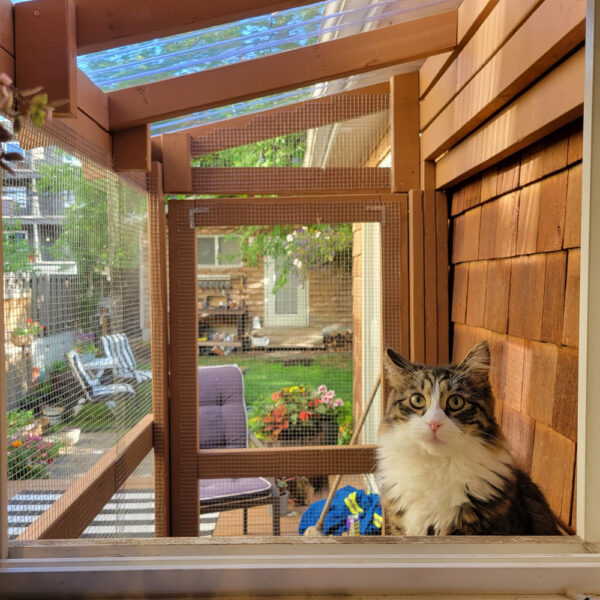
Welfare organisations put a lot of emphasis on one idea: the cat should have a choice. Cats Protection explains that the best outdoor enclosures are ones a cat can enter and leave freely, such as a catio connected to the house by a cat flap, window or door. The cat can go out when it wants to, and come back inside whenever it wants to.
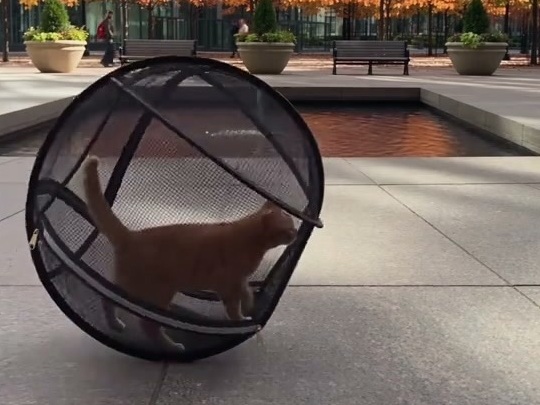
Freestanding pens and runs are different. These are not joined to the house, so the cat has to be placed inside and cannot choose when to leave. Cats Protection does not recommend them, because a cat that cannot leave can feel trapped and stressed: a pen is not a small catio.
It is worth being honest about what short sessions and close supervision can and cannot do. They reduce some risks, but they do not make up for the missing choice. A cat in a pen still cannot walk away when it has had enough. So a portable pen, if used at all, should only ever be an occasional outing for a cat that clearly enjoys being in it, never a routine and never a substitute for free access. If the cat is reluctant to enter, or shows any sign of stress once inside, the pen is not working for that cat.
Free roaming: a balanced view
It is tempting to frame free roaming as simply wrong, but the picture is more balanced than that. Roaming gives a cat territory, choice and the full range of natural behaviours: exploring, climbing, hunting and meeting other cats. For some cats, especially confident adults in quiet rural areas, that freedom is a real part of their wellbeing.
The risks are real too: traffic, predators, fights, disease, parasites, getting lost, and the harm cats can do to wildlife. In a busy town or near a main road, those risks weigh heavily. Many owners decide the balance is not worth it; others, in quieter places, accept some risk and keep their cat in at night, when road accidents are more likely to happen.
Neither choice makes someone a bad owner. What matters is that the decision is made with open eyes, for your cat, in your area, not from habit or guilt.
Before the first outing: the vet checklist
Before any outdoor time, run through a short checklist with your vet:
- Vaccinations are up to date, including against the diseases common in your area.
- Parasite prevention is in place, including appropriate flea and worm treatment, and tick prevention if relevant.
- Microchip and ID are sorted, so your cat can be identified if it escapes. In England this is not optional: since 10 June 2024, owned cats must be microchipped by the time they are 20 weeks old, including cats that live indoors, and keepers can face a fine of up to £500. An indoor cat can still slip out through an open door, and a chip with up-to-date details offers a way to reunite you.
- Neutering is done, unless there is a veterinary reason not to. Unneutered cats roam further and are more likely to fight or get lost.
If your cat has a health condition, is very young or elderly, or is on medication, ask your vet first.
Reading your cat: curiosity or stress?
The most useful skill for supervised outdoor time is reading your cat. Curiosity looks relaxed: ears and whiskers forward, slow movements, sniffing, tail held neutral. A cat that is enjoying itself will explore in its own time.
Stress looks different: ears flattened, body low and tense, tail tucked or lashing, pupils wide, freezing, panting, or trying to hide or escape. If you see these signs, the session is over. My own cat, Pupu, a three-year-old Maine Coon, taught me this gently: on some days he is all curiosity at the garden door, and on others the window perch is quite enough, and I let him set the pace.
If a cat panics outdoors, stay calm and avoid chasing or grabbing it where possible, as this could make matters worse. If your cat has direct, safe access to the house, stand back and allow it to return indoors.
However, if your cat is inside a freestanding pen, do not simply open the enclosure outdoors, as a frightened cat could escape. Keep the pen securely closed and reduce any nearby noise or activity. Arrange a safe way to bring your cat indoors without creating an escape route. Depending on the enclosure, this may mean moving it safely while closed, if it is designed for that purpose, or transferring the cat into a secure carrier in a fully enclosed area.
Once indoors, allow your cat to settle somewhere quiet and familiar.
The first session: keep it short
For a first outing, five to ten minutes is a useful guide, not a target to reach. Some cats will be ready to come in after two minutes, and that is a successful session. Let the cat’s behaviour decide when to stop, not the clock.
Choose a quiet spot, ideally somewhere the cat already knows through a window. Go out at a calm time of day. Stay with your cat the whole time. Supervised means you are there, watching, not indoors with the cat outside alone.
Give a treat when you go back inside, so coming home feels rewarding. If the first session goes well, build up gradually. If it does not go well, go back to indoor enrichment and try again another day, or not at all.
Enrichment: making outdoor time worthwhile
A bare enclosure with nothing in it is not enrichment. Wherever your cat spends outdoor time, give it things to do: a hiding spot to retreat into, something to scratch, a toy, a patch of grass or catnip to sniff, and both sun and shade so it can choose.
Fresh water should always be available, and shade is essential in warm weather. Cats can overheat quickly in a closed mesh space in direct sun.
Indoors, the same thinking applies. The RSPCA’s guidance on keeping cats indoors makes the same point: climbing shelves, window perches, puzzle feeders and daily play all give an indoor cat the stimulation it would otherwise look for outside.
Common mistakes
- Leaving the cat alone outdoors, even in an enclosure. Supervised means supervised.
- Forcing a nervous cat out, or picking it up and placing it in a pen. Reluctance is information.
- Skipping the vet check, especially vaccinations, parasite prevention and microchipping.
- Treating a portable pen like a catio. They are not the same, and the pen is not right for every cat.
- Long first sessions. A few good minutes beat an hour that ends in panic.
When outdoor time is not right
For some cats, outdoor time is simply not a good idea: very anxious cats, cats with certain health conditions, cats that panic at unfamiliar sounds, and cats that have never shown any interest.
A cat thriving indoors does not need to be “fixed” with outdoor time. The goal is a happy cat, not an outdoor cat.
A final thought
Indoor cats can live rich, happy lives, with or without outdoor time. If you do offer it, keep the cat’s choice at the centre: short sessions, close supervision, a way back inside, and stopping when your cat says so.